Social story · 10 pages
Eid day

Page 1 of 10
Muslims have two Eids every year: Eid al-Fitr after Ramadan, and Eid al-Adha.
Source: Sunan Abi Dawud 1134, graded sahih by al-Albani

Page 2 of 10
Eid is a happy day. The Prophet ﷺ said: "Every people has its Eid, and this is our Eid."
Source: Sahih al-Bukhari 952; Sahih Muslim 892

Page 3 of 10
On Eid morning, I wash and put on clean clothes. Sometimes they are new.

Page 4 of 10
On Eid al-Fitr, we may eat a few dates before we go to the prayer.
Source: Sahih al-Bukhari 953

Page 5 of 10
Many people come to the Eid prayer. It can be busy and loud.

Page 6 of 10
If it feels too loud, I can hold my grown-up's hand or wear my ear defenders.

Page 7 of 10
People smile and say "Eid Mubarak". I can say it too, or I can wave.

Page 8 of 10
Some people like to hug. If I do not want a hug, I can say "No, thank you" and wave instead.
Page 9 of 10
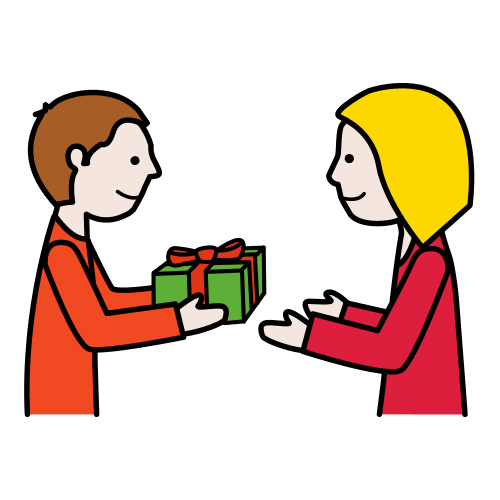
We may visit family and friends. Children sometimes get gifts.

Page 10 of 10
Eid can be a busy day. At the end of the day, I can rest in a quiet place.
For grown-ups
Eid changes the usual routine. Show your child the plan for the day in pictures, and agree on a quiet place and a sign for "I need a break".
Sources
- Sunan Abi Dawud 1134, graded sahih by al-Albani
- Sahih al-Bukhari 952
- Sahih Muslim 892
- Sahih al-Bukhari 953
Faith lines come only from the Quran and from hadith graded sahih or hasan. Scholars differ on some details, so ask a scholar you trust.
Pictograms: Sergio Palao, ARASAAC (arasaac.org), Government of Aragón, under the Creative Commons BY-NC-SA licence.